

![[Logo: Institute for Automotive Engineering (ika)]](https://ika.rwth-aachen.de/images/ika-logo-a-blau-blau-rgb.svg)
Dissertation
User-centered approach to vehicle cabin climatization
- Author:
- Thomas Hirn
- Pages:
- 207
- Keywords:
- Klimatisierung, Fahrzeuginnenraum
- Year:
- 2025
- Language:
- Format:
- ebook
The field of vehicle engineering, and in particular automotive engineering, currently faces two major transformations. Firstly, alternative propulsion is being widely adopted. This fundamentally changes the energy supply (electricity, heat) within the vehicle. Secondly, automated driving makes significant advancements. This will soon allow for entirely new vehicle concepts. Available vehicle climatization systems are becoming increasingly incompatible with these two developments.
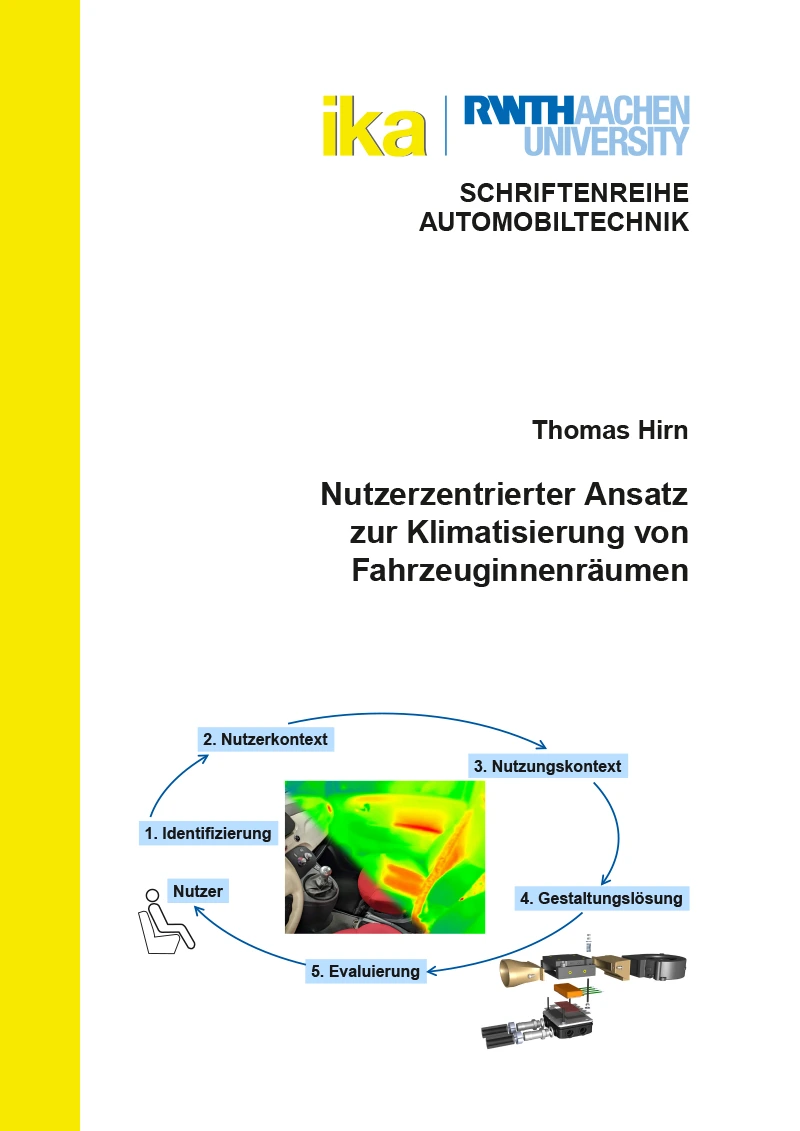
This work presents a new approach to vehicle cabin climatization, especially for future automotive interiors. An iterative, user-centered development method aligns the development of climatization systems with vehicle users and their needs. In a first step, users are identified. Secondly, within the user context, specific users and their goals, tasks and requirements are described. Thirdly, the interdependence between humans, vehicles and the environment is investigated. Thereby, concrete climatization demands as well as vehicle resources available for the climatization are derived. Based on these results, as a fourth step the novel climatization system is developed. The fifth step evaluates the new design against the previously identified requirements.
The proposed development method is applied to a research vehicle and four representative users. The derived technical solution consists of a climatization system located close to the users. It comprises components such as an active seat air-conditioning, a heated and cooled safety belt and radiant heating surfaces in the footwell. To locally heat and cool the users, decentralized climate modules based on thermoelectric heat pumps are implemented. This novel design represents a potential form of future vehicle cabin climatization. It is prototypically implemented into the research vehicle.
The new, user-centered climatization system is evaluated with regard to nine requirement categories: thermal comfort, safety, cost, air quality, acoustics, user interaction, environmental impact, vehicle integration and energy. The prototypical implementation of the new design slightly outperforms state-of-the-art air conditioning. Most noteworthy is the energy aspect: in the experiments the novel cabin climate control system decreased the electrical energy demand by 58 % to 90 %. The new climatization system also offers benefits in other functional aspects, including air quality, acoustics and usability. Challenges include the cost, size and mass of the prototypical design. The potential for cost optimization as well as expected advances in thermoelectricity make the novel climatization system a promising concept. Overall, this work contributes to usercentered climatization solutions for tomorrow’s vehicle concepts.
Service
Cooperations
Address
Institute for Automotive Engineering (ika)
RWTH Aachen University
Steinbachstraße 7
52074 Aachen · Germany
+49 241 80 25600