

![[Logo: Institute for Automotive Engineering (ika)]](https://ika.rwth-aachen.de/images/ika-logo-a-blau-blau-rgb.svg)
Dissertation
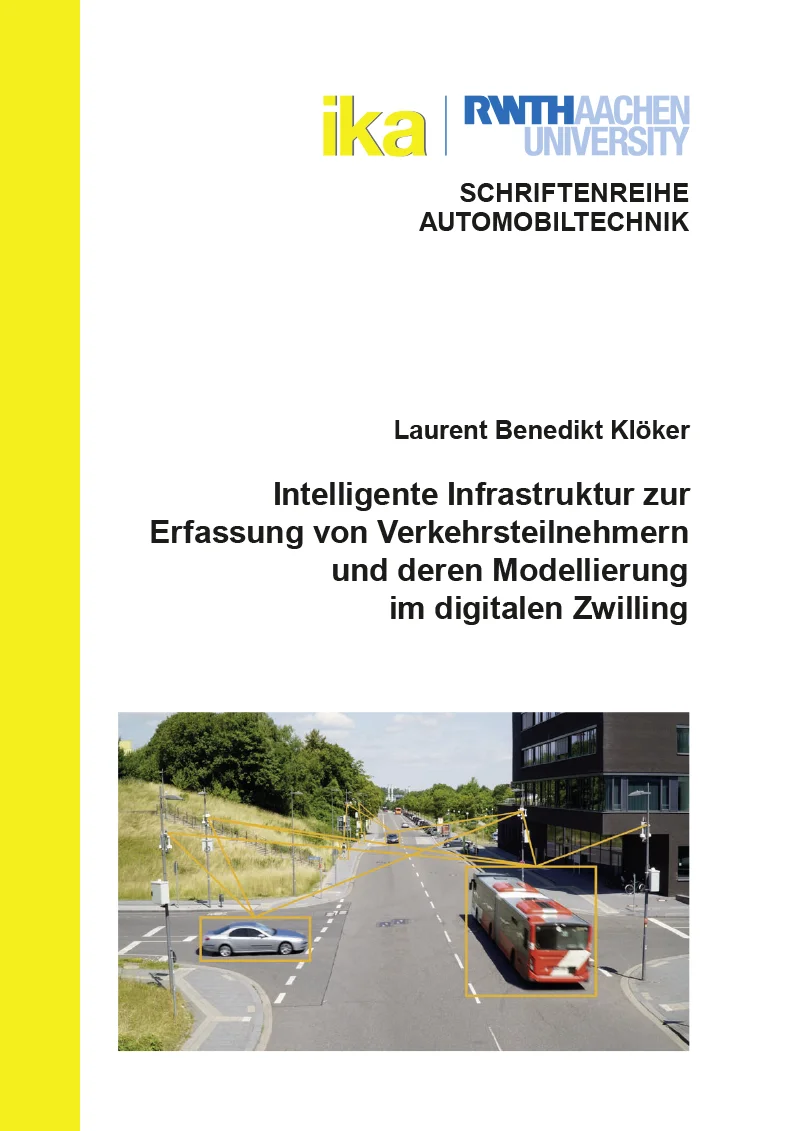
Intelligent Infrastructure for the Detection of Road Users and Their Modeling in the Digital Twin
- Author:
- Laurent Benedikt Klöker
- Pages:
- 173
- Keywords:
- automated and connected driving, environment perception, intelligent infrastructure sensors, life cycle cost analysis, multimodal sensor systems, quality metrics, sensor placement optimization, simulation-based evaluation, straffic digital twins
- Year:
- 2026
- Language:
- Format:
- ebook
The integration of automated and connected vehicles into existing transportation systems promises significant advantages in terms of safety, efficiency, and sustainability. However, this integration also poses substantial technological challenges, particularly in urban environments. Complex traffic scenarios, high traffic density, and frequent occlusions impede the reliable and precise perception of the surroundings by automated vehicles. In addressing these challenges, the use of intelligent infrastructure sensors (IIS), consisting of sensors installed in the road traffic to record and interpret traffic events, is regarded as a promising approach.
This dissertation proposes a systematic methodology for the assessment and optimization of intelligent infrastructure sensors, with the objective of creating digital twins. Digital twins, in this context, refer to the virtual representation of real-world traffic scenarios, serving as essential tools for the development, simulation, and validation of automated driving functions.
The work commences with a detailed simulation-based analysis of the potential of multimodal IIS configurations, particularly those combining camera and lidar sensor technologies. Based on these findings, specific evaluation metrics are defined that quantify the dimensions of accuracy, latency, and reliability, as these directly affect the functionality and safety of automated vehicles. The developed methodology is subsequently validated using real-world datasets from urban traffic nodes in order to derive robust and application-relevant insights into the suitability and transferability of the resulting digital twins for traffic-related use cases.
To further enhance its practical applicability, the methodology integrates spatial and economic considerations in addition to technical criteria. An algorithm is developed to determine optimized placements of IIS setups based on real road geometries. This algorithm takes into account technical requirements such as sensor coverage and resolution in safety-critical road areas. In addition, a comprehensive life cycle cost analysis is conducted using Monte-Carlo simulations to evaluate investment, operational, and total life cycle costs across different IIS configurations and deployment scales.
The results demonstrate that the proposed methodology provides a high degree of flexibility and transferability. It is suitable for addressing various requirements and application scenarios in the context of traffic-related digital twins. As a result, the work provides IIS operators, urban planners, and developers of automated driving systems with a scientifically grounded decision-making basis to systematically improve the quality of digital twins and sustainably optimize urban mobility systems.
Service
Cooperations
Address
Institute for Automotive Engineering (ika)
RWTH Aachen University
Steinbachstraße 7
52074 Aachen · Germany
+49 241 80 25600