

![[Logo: Institute for Automotive Engineering (ika)]](https://ika.rwth-aachen.de/images/ika-logo-a-blau-blau-rgb.svg)
Dissertation
Assessment method for ecological sustainability aspects of car body structures
- Author:
- Sebastian Spohr
- Pages:
- 179
- Keywords:
- Bewertungsmethode, Karosseriestrukturen, Life Cycle Assessment, Nachhaltigkeit
- Year:
- 2025
- Language:
- Format:
- ebook
In order to mitigate the long-term consequences of climate change, there is an acute need for action. In particular, the emission of greenhouse gases such as CO2 must be limited immediately. The transport sector is responsible for a significant proportion of global greenhouse gas emissions, which is why vehicle manufacturers are under social and increasingly also regulatory pressure to limit the environmental impact of their vehicle fleets.
The common tool for recording the CO2 footprint of vehicles over their life cycle is Life Cycle Assessment (LCA). However, particularly in the case of motor vehicles, there is a lack of suitable standardization, which has a negative impact on the comparability of life cycle assessments from different sources. Furthermore, LCA does not allow for the evaluation of a variety of vehicle-specific environmental aspects that cannot be quantified directly as emissions.
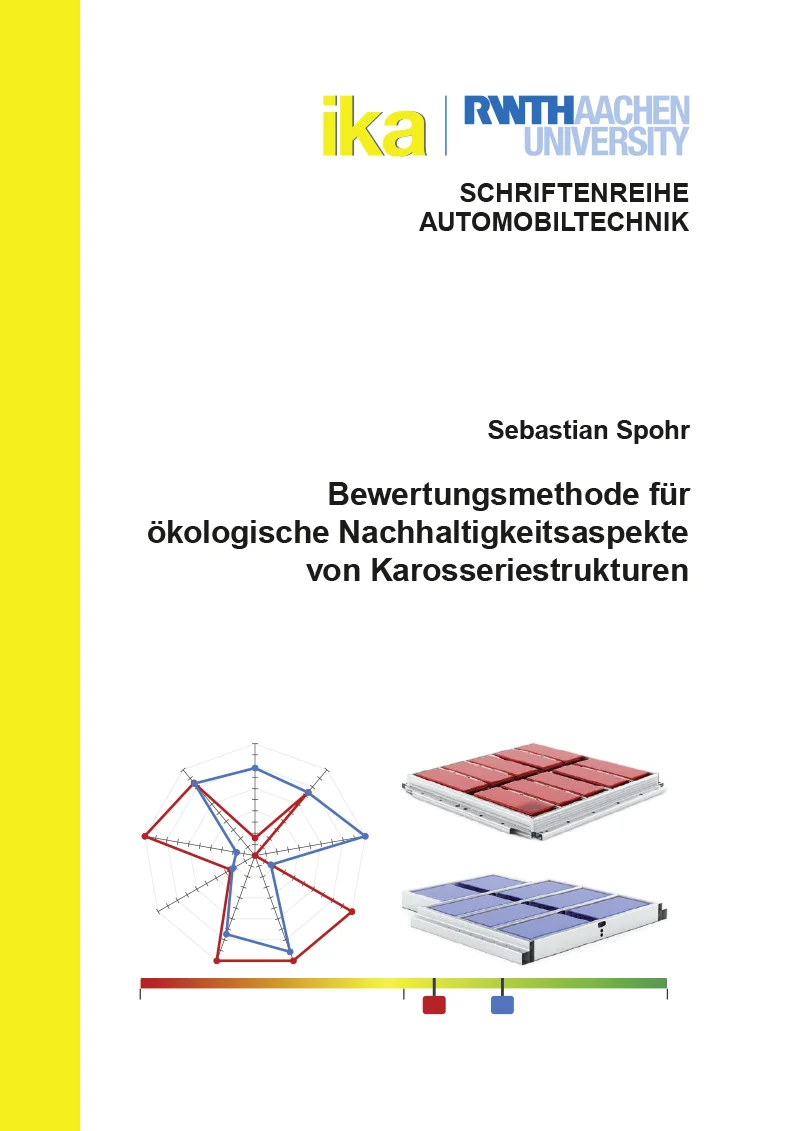
Within the scope of this thesis, a novel assessment method for ecological sustainability aspects of motor vehicles was therefore developed with a focus on vehicle body structures, which enables a transparent, comprehensible and holistic assessment of these. Based on a specially developed methodological approach, product-related environmental improvement strategies were analyzed in order to identify a total of nine assessment aspects that influence the environmental profile of car body structures. An individual calculation rule was defined for each of these influencing factors, which can be used to classify sustainability on a rating scale of zero to ten.
With regard to the production phase of car body structures, evaluation approaches were defined for the raw materials used, the number of different materials as well as production processes, joining technologies and corrosion protection measures. In the utilization phase, lightweighting and the dismantlability of joining technologies were evaluated. Finally, the dismantling effort and recyclability were evaluated for the end of life phase. In the final step, a reasoned weighting of the influencing factors Ei was carried out in order to calculate the evaluation factor B, the final result of the method. Finally, the practical applicability of the developed evaluation method was validated using two battery housing structures. It was thus possible to define a comprehensible and transparent assessment method that combines the emission-based assessment of LCA with vehicle-specific aspects without compromising the universal applicability of LCA. In addition, it was shown that the method can be used for a large number of different body structures and can be adapted to changing boundary conditions or priorities with little effort.
Service
Cooperations
Address
Institute for Automotive Engineering (ika)
RWTH Aachen University
Steinbachstraße 7
52074 Aachen · Germany
+49 241 80 25600